
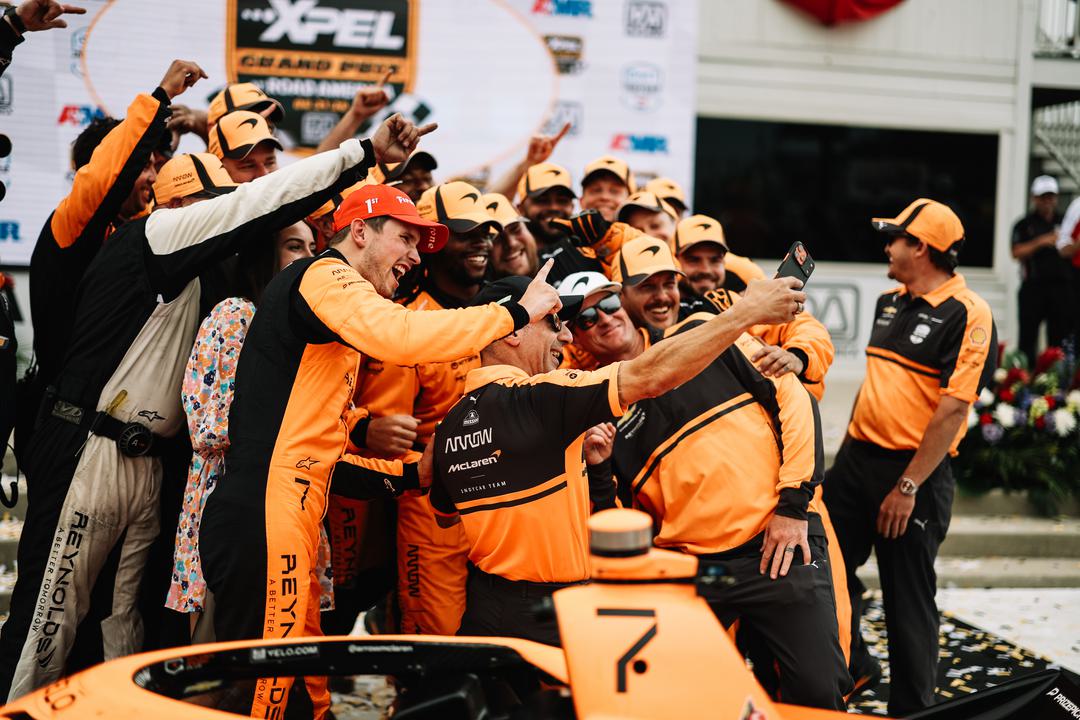
The 2026 XPEL Grand Prix at Road America had everything an IndyCar fan could want: strategy gambles, controversial officiating decisions, mechanical heartbreak, a last-lap incident, and a winner who seemed completely out of contention less than a lap after the green flag waved.
When the dust settled on one of the most unpredictable races of the season, it was Christian Lundgaard standing on the top step of the podium for Arrow McLaren, earning his second road course victory of 2026 after charging from the back of the field. It was a remarkable recovery drive that even left the winner asking his team over the radio, “How did we do that?”
Yet as impressive as Lundgaard’s victory was, the story of the day may have been the one that never reached Victory Lane.

Armstrong’s Cruel Ending
For much of the afternoon, Marcus Armstrong looked destined to earn the first IndyCar victory of his career.
The Meyer Shank Racing driver had been one of the fastest cars all weekend and executed a nearly flawless race. His strategy was sharp, his pace was exceptional, and his pit crew delivered when it mattered. As the laps wound down, Armstrong appeared firmly in control of the race.
Then disaster struck.
With fewer than five laps remaining, Armstrong’s Honda powerplant failed while leading, ending what had been the drive of his IndyCar career. The failure handed the lead to Lundgaard and transformed a likely first career win into one of the most painful retirements of the season. Honda officials later acknowledged the failure and apologized for the mechanical issue.
What made the situation even more heartbreaking was the reaction from Lundgaard himself. The race winner admitted afterward that Armstrong likely deserved the victory and noted that catching the New Zealander would not necessarily have meant passing him.
For Meyer Shank Racing, it was a devastating swing. Armstrong lost a likely victory while teammate Felix Rosenqvist, who led the most laps during portions of the race, saw his strategy compromised by caution periods and ultimately finished outside the podium positions.

The Yellow Flag Debate
Road America’s four-mile layout has long created unique challenges for race control, and Sunday’s race reignited the debate over when IndyCar should deploy full-course cautions. On Sunday, several incidents triggered yellow flags that dramatically altered race strategy and shuffled the running order.
The most controversial came after Armstrong’s mechanical failure. The Meyer Shank driver was able to safely guide his disabled car off the racing surface and into a runoff area, many observers expected a local yellow rather than a full-course caution. Instead, race control neutralized the entire field, setting up a late restart and fundamentally changing the complexion of the finish. The decision followed earlier controversy involving Romain Grosjean, whose loose wheel and subsequent spin also triggered a caution period.
Drivers and media members alike expressed confusion over the consistency of the calls. Will Power was among those openly questioning the decisions after the race, highlighting the ongoing tension between maintaining safety and preserving competitive integrity.
The irony, according to some observers, is that bunching the field together for late-race restarts can sometimes create more dangerous situations than the incidents that originally triggered the cautions.
Whether IndyCar adjusts its approach moving forward remains to be seen, but the discussion is unlikely to disappear anytime soon.

Malukas Continues His Championship Charge
While Lundgaard collected the trophy, David Malukas may have left Road America with just as much momentum. The Team Penske driver finished second yet again, continuing one of the most impressive consistency runs in the series. It was another example of why Malukas has become one of the most compelling stories of the 2026 season.
The victory continues to elude him, but his ability to consistently finish near the front has elevated him into a legitimate championship contender. Malukas now sits second in the standings and continues to outperform expectations in his first season with Penske. Perhaps most impressively, he has shown competitive pace on every type of circuit. Ovals were expected to be a strength. What has surprised many is how strong he has become on road and street courses as well.
The question surrounding Malukas is no longer whether he can win. It’s when. And, if those wins begin arriving during the second half of the season, the championship picture could become very interesting.

Palou Finally Shows He’s Human
Championship leader Alex Palou started the race on Sunday looking untouchable once again. The Chip Ganassi Racing driver continued his remarkable qualifying form by claiming his 5th pole position in a row, extending one of the strongest qualifying stretches in IndyCar history. After the green flag flew, he built a huge lead during the first stint of the race. But for one of the few times this season, Palou made a costly mistake.
A pit lane speeding penalty dropped him deep into the field and forced him into recovery mode. The error was entirely self-inflicted, something Palou readily admitted after the race. Despite the setback, he fought back to finish fifth in a performance that allowed him to maintain his position as the championship favorite. The result, while not disastrous, did reveal that Palou is not in fact, invincible.

A Championship Worth Watching
With eight races remaining, there are now at least four drivers with a realistic path to the championship. The standings still favor Palou, and he controls his own destiny, but Road America may be remembered as the weekend that transformed the title race from another coronation into a contest. Malukas continues to pile up podium finishes. Lundgaard now owns multiple victories and seems to have found his footing on road courses. Kyle Kirkwood, the king of the streets, remains within striking distance with both Markham and D.C. street circuits ahead.
If Road America taught us anything, it’s that IndyCar remains the most unpredictable major motorsports series in the world. A driver can go from last to first. A likely first-time winner can lose everything with four laps remaining. And a championship that looked settled a month ago suddenly feels very much alive. As the series heads to Mid-Ohio, one thing is clear: the second half of the season just got a lot more interesting.


