
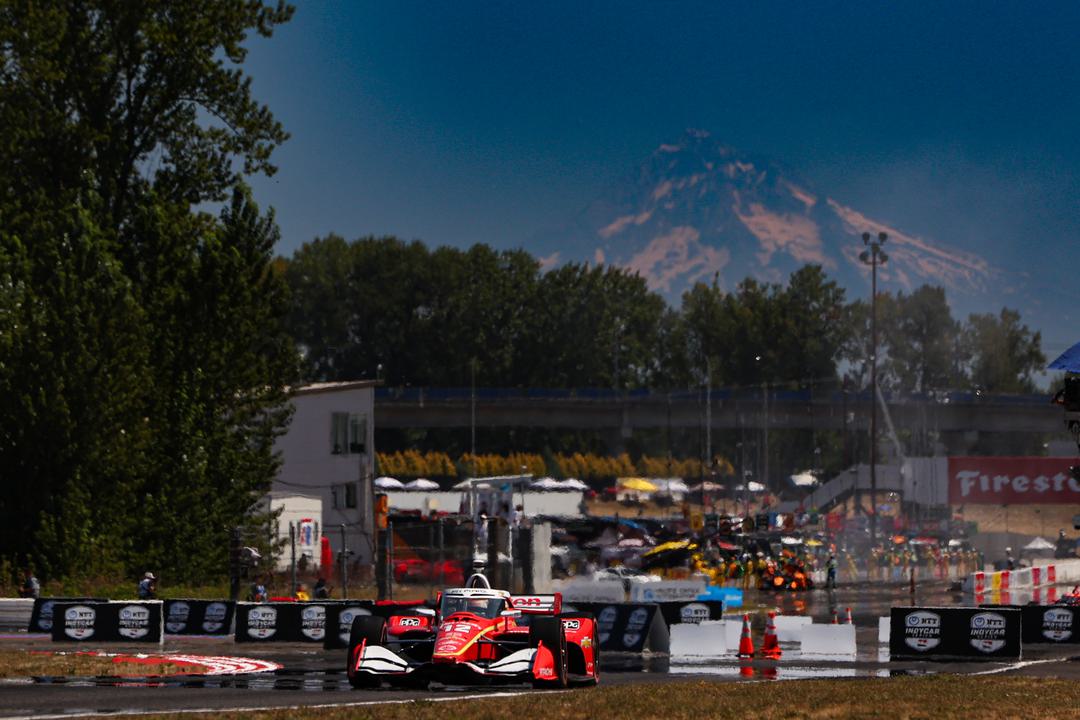
Perhaps one of the most unusual venues for IndyCar is Portland, Oregon. It’s not a huge market like Long Beach, and it’s not a legendary track like Indy, but Portland International Raceway has had staying power through CART, ChampCar, and now IndyCar. The drivers love racing on Portland’s flowing 12-turn track, and everyone loves coming to soak up Portland’s well-deserved reputation as a fun town to visit.
Born in the War
The foundations of Portland International Raceway were literally laid as part of the all-out effort to win World War II. Henry Kaiser built an entire town called Vanport in just 6 months, to house the shipyard workers who were building the American merchant fleet.
After the war ended, Vanport remained until a massive flood in 1948 washed the town off the map. But when the waters subsided, the streets of Vanport were left behind. In 1961, those streets became a race course that evolved into the current configuration of PIR.

A Quick Lap
Portland’s front straight (known as Cottonwood Avenue during the war) is arrow-straight and the cars run due west. This generally only becomes an issue when the sun goes down at the end of the day, and won’t be a factor in most IndyCar races. The start/finish line at PIR is about 2/3 of the way down this straight, giving drivers a good run at the green flag, and again at the checker.

Turn one is a 90-degree right turn similar to a street course, into the Shelton Chicane, named for the beloved local Trans-Am racing hero Monte Shelton. There’s a short chute to an acute left, and then another short run to a light right turn back onto the main straight. The Chicane, as it’s generally known, is a prime place to watch the action, as passes take place under braking, and in the quick set of turns. A wrong move here can spell disaster, or set a driver up for success. The chute between turns one and two is also the slowest point on the track.
After the chicane, turns four and five at Portland make a double-apex turnaround at the far west end of the course. These turns also begin a flowing set of highly technical corners that lead to Portland’s back straight. The most recent repave of Portland changed the flow substantially, by shortening the distance to the sweeping left-hander of Turn 6, and then making the track absurdly wide heading to the right-hand Turn 7. The wide entrance and narrow exit from Turn 7 offer challengers several different lines to attack a car in front, and it’s difficult to defend a position here. It’s also easy to go off driver’s left on the exit of Turn 7 if a driver miscalculates.
Turn 8 is hardly a turn at all, just a rightward jink onto Portland’s wide back straight – which isn’t straight at all. The back “straight” is an extra-long smooth gentle arc to the right, technically called Turn 9. It’s among the fastest parts of the track, and it leads to the ultra-technical final part of the course, known as “The Circus.”
At the end of the sweeping back straight, drivers face a roughly 30-degree left-hand corner called Turn 10, and then a very short transition to the right-hand Turn 11. Turn 10 can be taken almost at full speed, but carrying that speed into Turn 11 can fling a car right off the track. Drivers have to manage the left-right transition with speed control, because 11 leads to an extremely short braking zone to Turn 12, the turnaround onto the front straight. Done correctly, 10-11-12 are a dance, but here again, multiple available racing lines and a hard braking zone deliver a lot of action. Races can be won or lost in the Circus.
It’s the combination of a flowing, technical course with a few very specific challenges that lead IndyCar and other drivers to appreciate Portland. The track is known as a place where the drivers really have to race each other, rather than relying on pit stops or other factors. Ask any IndyCar driver who has won at Portland, and they’ll tell you it’s an achievement.

The Rose City
Apart from the race track, which offers many great and affordable places to watch the action, Portland is a banquet. Forget anything you’ve seen on the news, except maybe the Unipiper, and come enjoy one of America’s premier cities for food and drink. Portland restaurants are a foodie paradise, and the town’s reputation for craft brewing, coffee, and a thriving night life are well-earned. There are several large hotels within a mile or so of the race track, and ample opportunities to camp at the facility.
If you’re looking for a glamorous dining experience, head to downtown Portland where expert chefs can be found on every block. But to avoid the wait for a table, Huber’s Cafe is a century-old landmark known mainly to locals. You really want the Spanish Coffee, but stop at one unless you’re taking an Uber back to your hotel. For the full Portland experience, check out Departure in The Nines hotel, or the Portland City Grill on the 30th floor of “Big Pink” – the US Bank building.
But if you’re looking for the real Portland, why not try my favorite spot? Po’Shines Cafe de la Soul is located in the Kenton neighborhood just south of the race track on Denver Ave. Whether it’s the grilled catfish, Hoppin’ John, greens, hush puppies, or the mac & cheese, Po’Shines has got soul food handled. Across the highway in the Mississippi Avenue district, you can take your pick of trendy spots, but I particularly like Prost!, a German restaurant with authentic food and of course, a great selection of beer.
If you’re looking for a unique place to stay, consider McMenamin’s Edgefield – literally the old Multnomah County Poor Farm, transformed into a boutique hotel with restaurants, pubs, its own wine and beer, and all the character you can stand. It’s located less than 10 miles from the track, an easy drive into town.
In any event, you’ll want to make your Portland trip extend a few days before or after the IndyCar GP, just to check out the town or head up the Columbia River Gorge for a day.


